



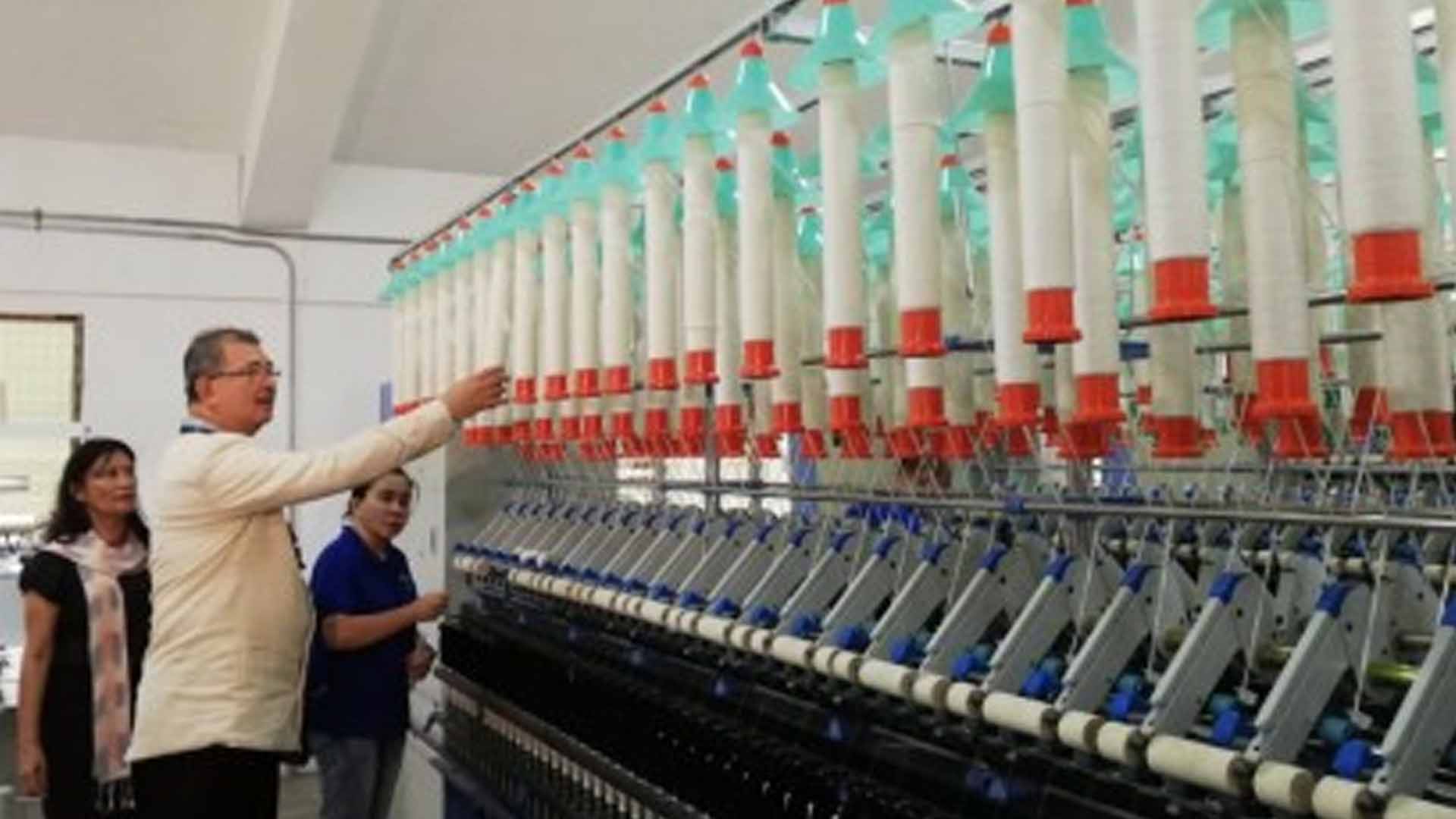






The hablon-weaving town of Miagao, Iloilo province can take additional pride for its hand-woven textile as its raw materials are grown from its soil.
This, as the Regional Yarn Production and Innovation Center (RYPIC) was unveiled at the Iloilo Science and Technology University (ISAT U) in Miagao Campus.
The RYPIC, which will turn the town’s cotton and other raw materials into yarn, was financed with the PHP42-million fund of the Department of Science and Technology (DOST) through its Grants-In-Aid Program.
DOST Secretary Fortunato de la Peña, in a media interview, said the establishment of the RYPIC completes the value chain of the weaving industry in Miagao town.
Weavers from Miagao use polyester yarns in their products, but with the RYPIC, de la Peña said the people in town can again fully claim that the product is from Miagao and made by Miagaowanons.
“The town is known for its weaving industry, even long before. In the past, the raw materials in weaving are also sourced here and the process is traditional from the harvest, into processing the materials into yarn, the weaving, and until making it into garments,” he said.
Celia Elumba, director of the DOST-Philippine Textile Research Institute (PTRI), said the blended yarns produced through the RYPIC, when turned into garments, also has a positive impact on the environment.
In a press conference, she said polyester is a non-biodegradable and leaves micro-fiber in water systems. “Every time we wash our clothes with synthetic materials, there are micro-fiber left in our waters. One study has claimed that a liter of water contains seven to eight pieces of micron of polyester,” she added.
Locally-produced yarn can also boost the market of the Miagao weavers, she said. There were weavers sent abroad who failed to sell their products as the costumers found out that they use polyester and not locally-grown materials, she said.
She said the RYPIC can produce 40 to 50 kilos of blended yarn per day or can make up to 400 to 500 shawls daily “if they can do it fast.”
The center is manned by 5 personnel trained under the DOST-PTRI, she said. These personnel are being eyed to also train the future generation on how to operate the facility.
Miagao Mayor, Dr. Macario Napulan, meanwhile, has expressed his gratitude since the center has finally been established in his town.
He said the RYPIC will ensure the sustainability of the weaving industry in Miagao as placing it in an education institute entices the younger generation to involve themselves in the town’s source of pride.
“We need to train our students because our weavers are not getting younger. They (weavers) have the talent and skills but we want them to pass it on to the next generation,” he said, noting that the town has now a total of 259 hablon weavers.
The bright future of the hablon industry is also assured as the ISAT U through its president, Dr. Raul Muyong, has committed to supporting the program.
With the establishment of the RYPIC on its premises, the ISAT U eyes to revive courses related to weaving and design.
Weaving courses have been offered in the university before but the intervention of technology has triggered change for curriculum and programs, he said.
“Now, we are happy that we have this facility in this university and this is an opportunity for us to offer new programs. We are planning to offer Bachelor of Science in Textile Technology and Design,” Muyong said.
He said the university, with the DOST-PTRI, is yet to develop human resources and facilities. The RYPIC can already be used as an instructional center for the course being eyed, he added.
In this light, it is not only the hablon industry that had been given the assurance of a bright future but also students, who will have a wider work opportunity when they finish the course, he said. (PNA)


