



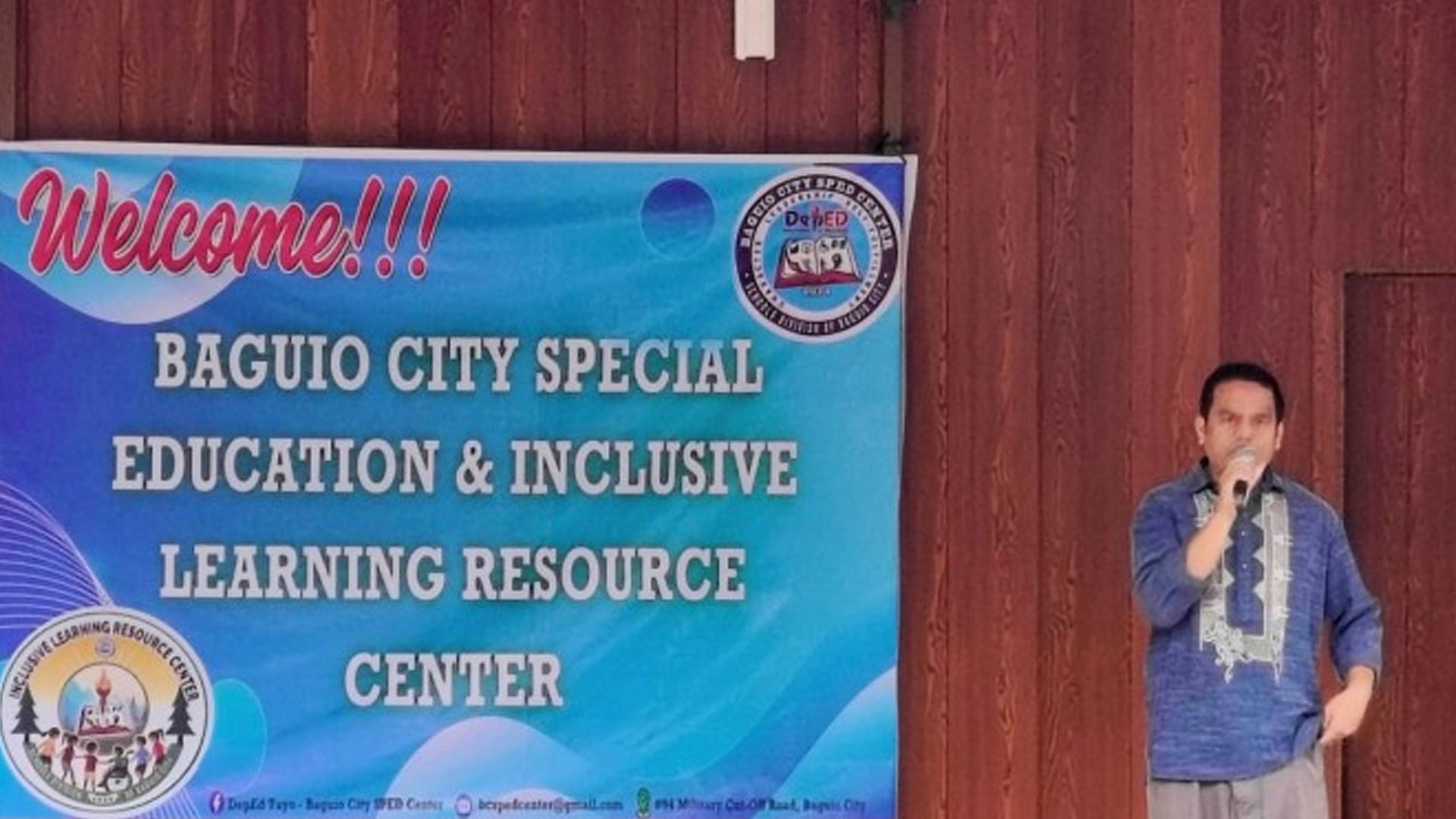






People with disabilities must not be kept at home, as they too can be taught to survive and live day to day by providing them with formal education to hone their skills in school.
“We cater to special children of all ages, and we adopt the education based on their assessed needs,” Dr. Rommel Manzano, principal of the government-run Special Pupils Education (SPED) Center in Baguio, said in an interview on Tuesday.
Currently, there are 845 learners enrolled at the SPED Center, of whom 293 are in special classes.
The learners have hearing impairment, intellectual disability, learning disability and autism spectrum disorder (ASD).
The Brigada Eskwela, which prepares the physical facilities for the learners, is more tedious than in a regular school.
“We do not just put decorations the way we want, nor hang or paste learning materials on the walls. Even the sizes of photographs need to be carefully considered, and they can be removed or changed even after they are already placed,” he shared.
He said that classrooms for learners with disabilities must be smaller than the usual size of a classroom to be able to contain the children, and they cannot be very decorative, as learners with ASD are distracted by color, decorations and the size of the photos they see displayed.
“We carefully plan the classrooms and even the surroundings. The preparation is more complicated than the other schools,” he added.
The first week of classes, called “opening block,” is not devoted to full learning because learners are assessed on their behavior in class, which could be a result of their surroundings.
“A special class must have only seven to 15 learners, but with the limited resources we have, we go as high as 20 in a class, except for the ASD classes, where there are only five,” he said.
He also said that there are learners who are not provided with academic learning but only life skills that they will need to survive in the outside world.
“To develop and improve the skills they already have, we also offer arts, crafts, kitchen tasks, and even baking if they are not into academics. Insisting on academics will just be frustrating if that is the only focus. That is why we assess how they handle their education,” he added.
As a former principal of a regular school, Manzano said he had to return to the university to earn a master’s degree in special needs education to better manage the SPED center.
Teachers are also Bachelor of Education graduates with majors in special needs education, allowing them to fully understand and better care for the learners.
He said the center is equipped with the kind of education the sector needs for them to survive in life, based on Republic Act 11650 (Instituting a Policy of Inclusion and Services for Learners with Disabilities in Support of Inclusive Education Act) that prescribes inclusive education.
All types of learners, typical and atypical, are placed together in one classroom to stay, play and learn with their counterparts.
“In Baguio, this is not yet possible because special training is needed to support learners with disabilities. In SPED, we have started inclusive learning, but it is different from what is done in a regular school. It will not be beneficial for those with learning disabilities,” he said.
SPED caters to learners with severe and profound cases who need teachers trained in curriculum and academics and in handling learners with disabilities, and their number continues to increase every year.
Those with mild cases, including the “fast learners,” can be accepted into regular schools to allow SPED to cater to children who are more in need of special education.
Emy, who asked that her full name be withheld, said her son, who has Down syndrome, needs to be taught differently from other children. Her son is 11 years old and is just learning how to speak.
“The care they need is different, and the carer must have a broader understanding and patience,” she said. (PNA)


