



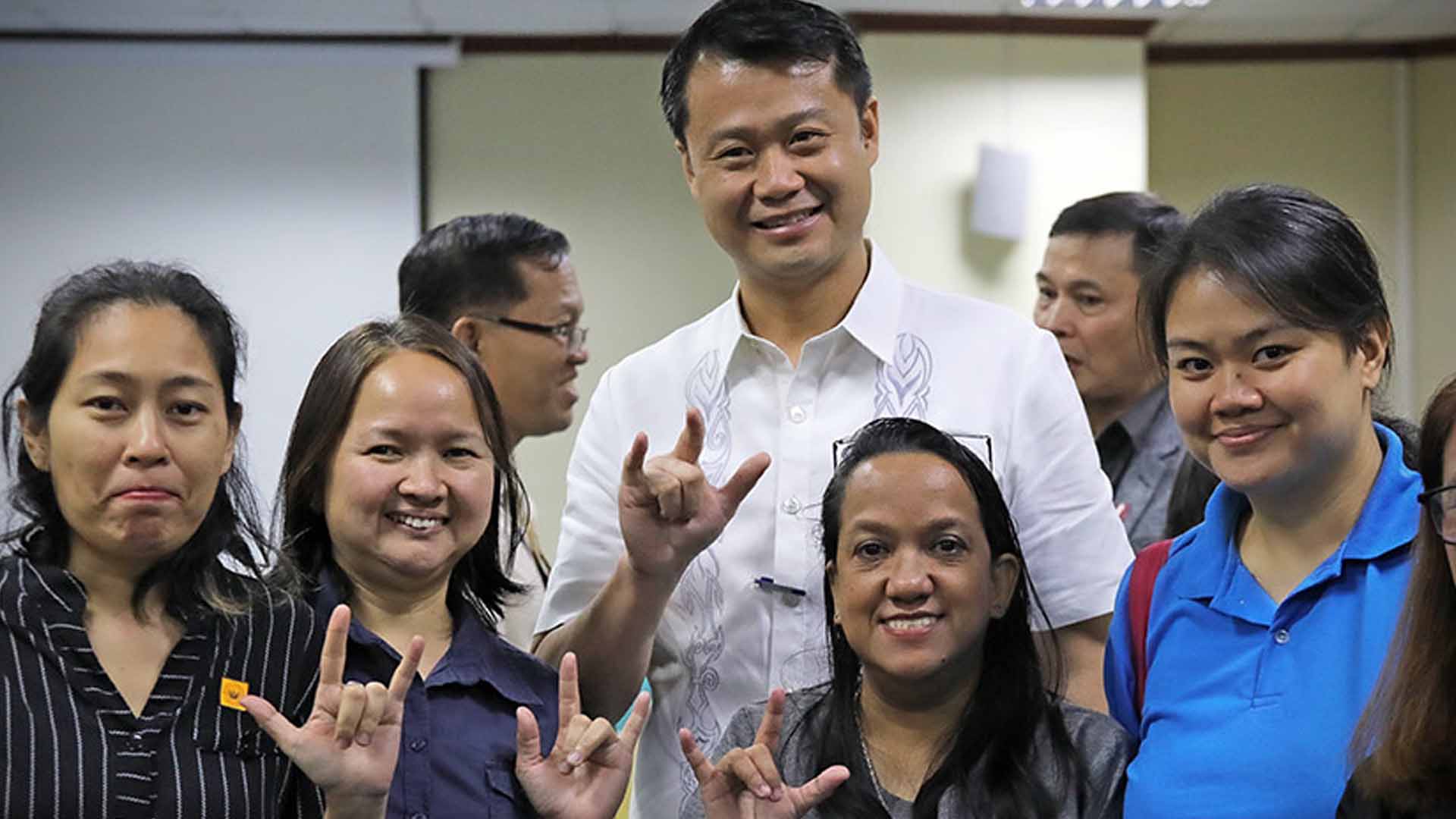






While access to learning remains a challenge for learners and teachers with disabilities amidst the COVID-19 pandemic, Senator Win Gatchalian is seeking an inquiry on the status of using the Filipino Sign Language (FSL) as the language of instruction of deaf education under the K to 12 basic education system.
To identify and address gaps, issues, and challenges on the use of the FSL for deaf education, Gatchalian filed Senate Resolution No. 722 to determine the impact of FSL’s use among deaf teachers and learners, which is mandated by Republic Act No. 11106 or the Filipino Sign Language Act.
Gatchalian lamented that the law’s implementation has been neglected, continuously causing communication, information, and institutional barriers in deaf education. These include insufficient training of teachers, the non-promotion of the licensing and mobilization of deaf teachers, and the lack of materials—challenges that are amplified under the distance learning setup.
Republic Act No. 11106, which was signed into law in 2018, declares the FSL as the country’s national sign language.
Before the law’s enactment, education programs for sign language instruction and interpreter training were all done by a handful of nonprofit organizations with no government policies. Teachers also used to act as interpreters in the classrooms and were pulled away from their duties to serve as interpreters in trial courts and police stations.
For the school year 2016-2017, data from the Department of Education (DepEd) shows that there were 2,885 Special Education Teachers teaching 13,365 learners with diagnosed hearing impairment under K to 12.
The lawmaker also pointed to the barrier facing deaf teachers since the Licensure Examination for Teachers (LET) does not match the competencies for which they are prepared for. Because of this, deaf graduates end up as tutors with low-paying jobs instead of entering the educational system.
“Noong isabatas ang Filipino Sign Language Act, sinikap nating maging mas madali para sa ating mga deaf learners at teachers ang makilahok sa sistema ng ating edukasyon, ngunit hanggang ngayon ay marami pa rin sa kanila ang nahihirapan. Kaya susuriin nating mabuti kung paano matutugunan ang mga suliraning ito upang hindi mapag-iwanan ang ating mga deaf learners at teachers,” said the Chairman of the Senate Committee on Basic Education, Arts and Culture.


