



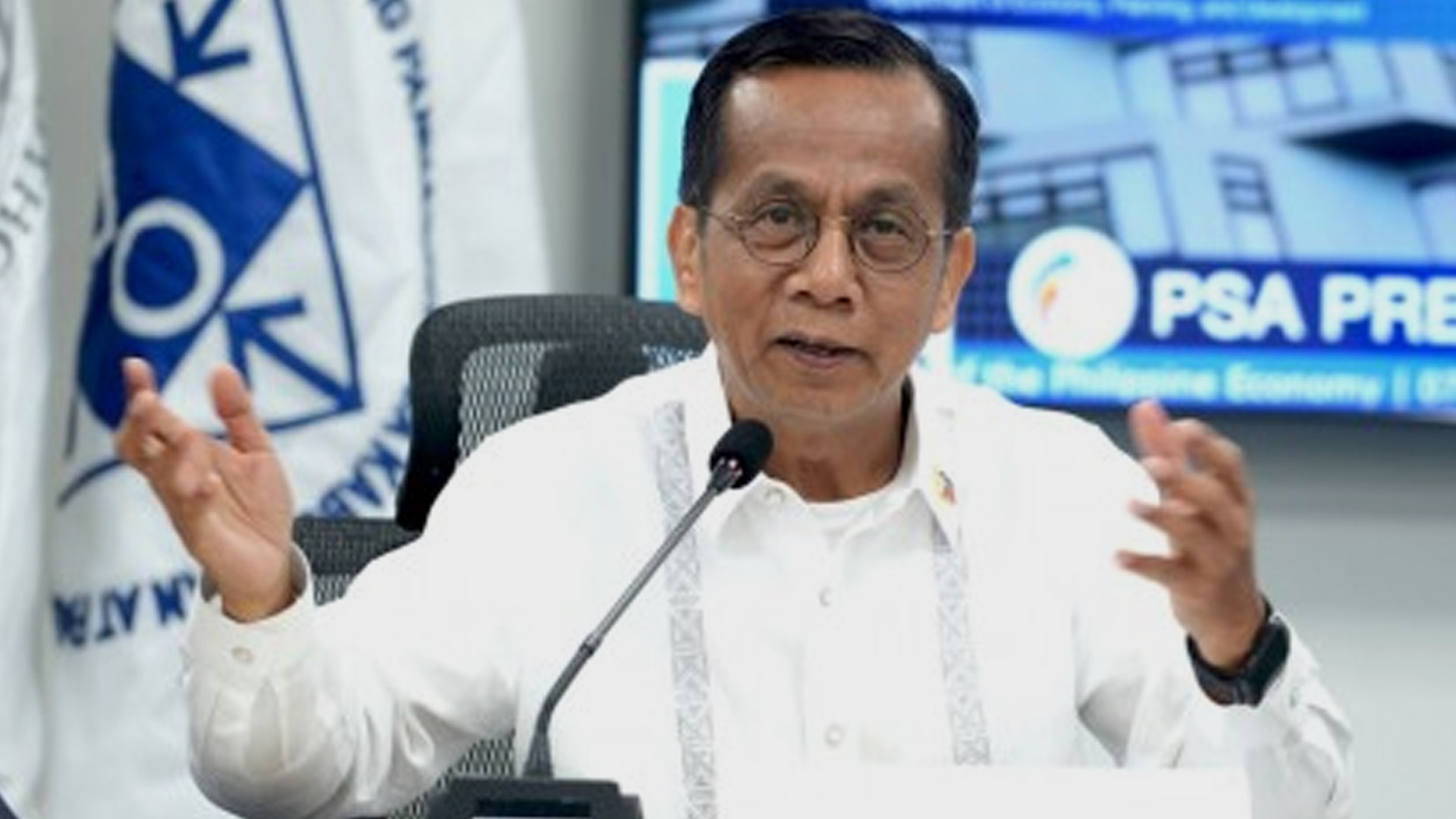







The Philippine government will continue to implement reforms to make economic growth more inclusive and to make sure that the country’s upper-middle income (UMIC) status will be sustained, Department of Economy, Planning, and Development (DEPDev) Secretary Arsenio Balisacan has said.
In a briefing on Monday, Balisacan said the Philippines is also unlikely to return to its lower-middle-income status despite global and local headwinds to growth.
Last week, the World Bank confirmed that the Philippines is now an upper-middle income economy, with a gross national income (GNI) per capita of USD4,850, surpassing the threshold for upper-middle-income countries.
Balisacan said that while the economy faced a combination of domestic and external shocks that slowed growth and pushed inflation higher this year, the government remains committed to strengthening the country’s growth.
“This means accelerating the implementation of strategic infrastructure and other high-impact public investments, while encouraging greater private investment. Faster implementation will stimulate economic activity, improve connectivity, strengthen productivity, and create quality jobs,” he said.
Balisacan said the government will also strengthen food and energy security and enhance climate resilience through investments in water resources, irrigation, flood control, and disaster preparedness.
He noted that the government also vows to raise the country’s productivity and competitiveness by investing in education, health, digital transformation, innovation, and workforce development.
Balisacan said the government must also continue to strengthen institutions.
“Transparent governance, sound public financial management, efficient regulation, and a predictable business environment are essential for sustaining investment, raising productivity, and ensuring that economic growth remains inclusive,” Balisacan said.
For this year, the government is aiming for a 3.5 percent economic growth. In 2027, growth is expected to accelerate to 5 to 6 percent.
“Our task now is to restore a higher and more sustainable growth path— one that is underpinned by rising productivity and innovation, resilient to shocks, and expands opportunities for every Filipino to participate in, contribute to, and benefit from economic progress. I remain optimistic,” Balisacan said.
“But I think an optimism that has a good grounding. For example, we have done, I mentioned, several reforms that have been implemented in the past. Not only during this administration, but even earlier. That has made our economy now more responsive to opportunities. We are now more open. We are a more open economy than we used to be two or three decades ago,” he added.
Balisacan said that since most of the neighboring countries are also aiming to achieve higher growth, this should push the Philippines to continue implementing reforms to sustain its growth.
“So the possibility of us going back to the lower-middle-income class is, I think, quite remote. Unless, you know, you have certainly a very bad development in our political economy. But we don’t see that, and we hope that we continue to progress in our push for reforms,” he said. (PNA)


