



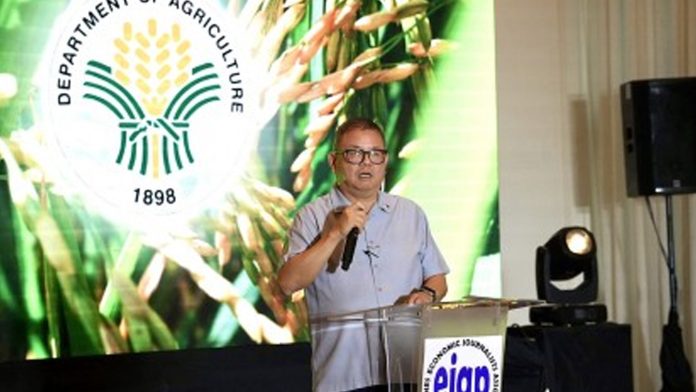






To protect the local palay (unhusked rice) industry, the Department of Agriculture (DA) on Thursday said it wants more investment support in local post-harvest facilities from rice importers.
The proposed measure will be under the Rice Industry and Consumer Empowerment (RICE) Act.
In an interview, DA Secretary Francisco Tiu Laurel Jr. said the proposal seeks to uphold the livelihood of Filipino farmers despite the presence of imported rice.
“Kung ikaw simpleng importer lang ng bigas, wala kang investment, wala kang binibili– technically, wala kang pakialam sa ating (If you’re just a simple rice importer, you don’t have investment, you are not procuring palay, technically you don’t care about our) farmers and rice processors,” he said on the sidelines of the Economic Journalists Association of the Philippines’ (EJAP) food security forum.
“You’ll just import rice as much as you can and technically papatayin mo lang ang (you’ll just kill the) local industry.”
In particular, the proposal seeks to impose post-harvest facility investment as a prerequisite in securing import allocation.
“Ibibigay natin ‘yung karapatang mag-import (We will grant the right to import) or the allocation to import to the ones who have invested in the industry and continuously buy palay, process palay for our farmers,” Tiu Laurel said.
Once passed, the policy will serve as the legal basis for the crafting of its implementing rules and regulations (IRR).
With this measure, reasonable profit for palay farmers is expected, provided access to more drying facilities.
“The general idea is that by 2028, if legally feasible, ang pwede lang dapat sana mag-import ng imported rice ay kung sino ang may mill, may (those who may be eligible for importation will be exclusive to those with) drying system, or complete system rice processing system,” he said.
“Kailangan mayroon siyang nabili sa farmer, mayroon siyang pinrocess, hindi lang basta-basta may facility ka kasi (They must secure purchases from local farmers, they processed it and not merely having a facility). That will protect the farmers, as well as consumers,” Tiu Laurel added.
To date, the majority or about 80 percent of rice importers in the country have no milling or drying facilities.
In 2025, some Filipino farmers sustained losses as farmgate prices of wet and fresh palay reportedly dropped to PHP5 per kilogram in Nueva Ecija, according to the Samahang Industriya ng Agrikultura.
The DA slammed some rice traders who have reportedly taken advantage of Filipino farmers and ensured necessary intervention during the tail-end of the harvest season in July last year. (PNA)


