



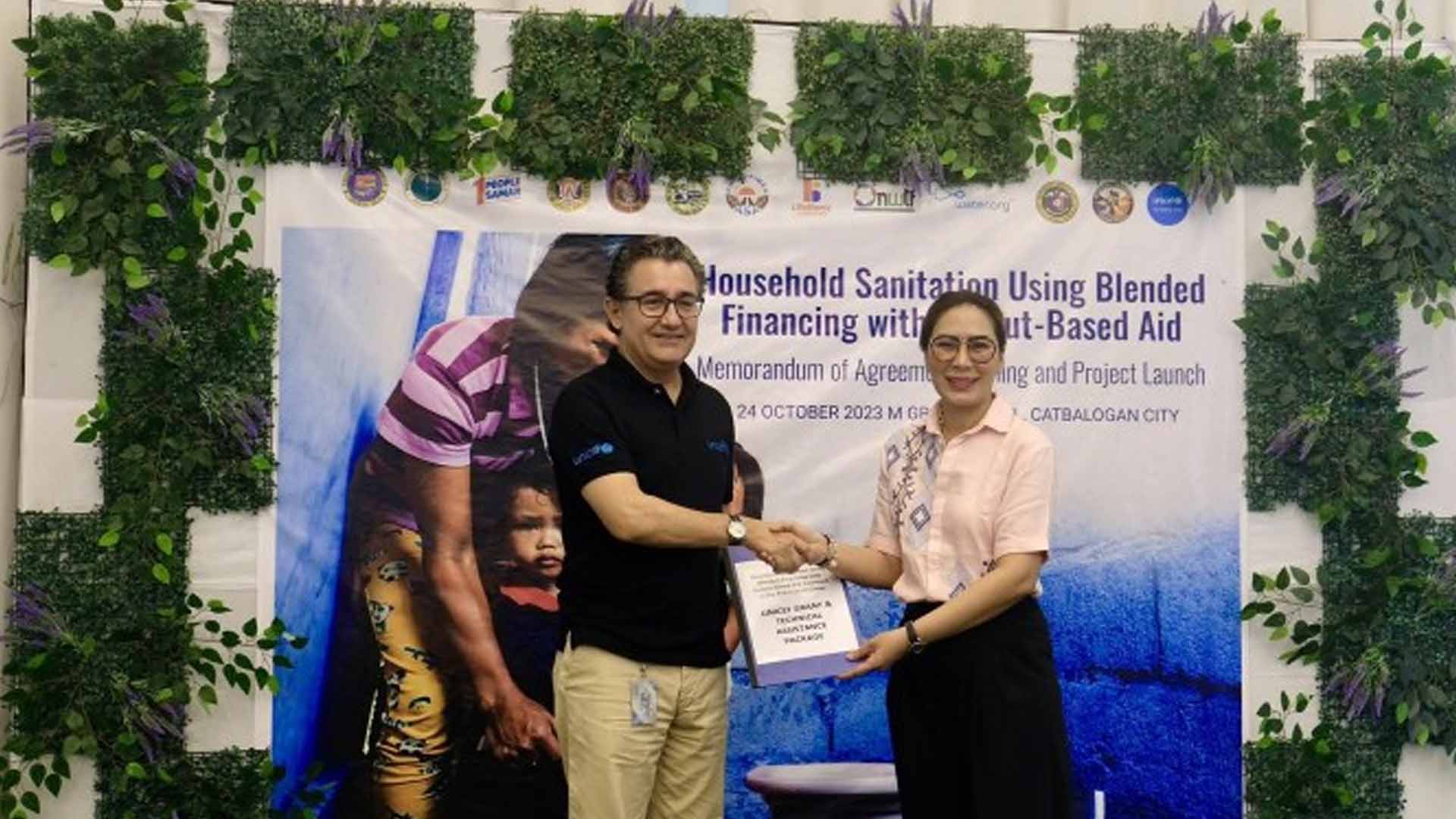






Samar’s provincial government on Wednesday signed a memorandum of agreement with microfinance institutions to make climate-resilient toilets affordable to 150 poor families in the province.
The project, supported by UNICEF, will benefit households in Basey, Jiabong, and Paranas towns.
At the signing, Samar Governor Sharee Ann Tan said the province and its partners invested in this financing initiative that would ensure the health and safety of poor families.
“Our province is highly vulnerable to experiencing adverse weather conditions, and having climate-resilient sanitation is one of the steps we’re taking to mitigate the risks and shocks associated with climate change,” Tan added.
The project will be implemented under two schemes – output-based aid and blended financing.
Under output-based aid, beneficiary households will be provided with PHP45,000, or about 85 percent of the cost, which will only be released after the verified completion of the toilet and compliance with Department of Health (DOH) standards.
For blended financing, households found eligible and willing to take a loan and pass the inclusion criteria verified by the town authorities, will be provided with a loan by microfinance institutions to cover the remaining cost of the toilet.
The cost estimate for a climate-resilient toilet with a double chamber septic tank and leach pit is at PHP53,000.
Microfinance institutions operating in Samar – ASA Philippines, LifeBank Philippines, and Negros Women for Tomorrow’s Foundation – would finance the total upfront cost for selected households.
Beneficiary households will later assign the subsidy certificates to the microfinance institutions to pay off 85 percent of the total cost of building the toilets.
The remaining 15 percent of the toilet cost, on the other hand, will be paid by the households to the microfinance institutions in 12 monthly installments.
DOH 8 (Eastern Visayas) Director Exuperia Sabalberino said having climate-resilient toilets that safely contain fecal matter could prevent contamination of groundwater and the environment, especially during disasters.
“Addressing the persistent threat of water-borne diseases remains one of the most formidable challenges during disasters. We welcome this breakthrough initiative and the steadfast commitment of Samar province and its towns to channel resources into establishing climate-resilient sanitation solutions for vulnerable communities,” Sabalberino added.
The project is supported by UNICEF Philippines as part of its commitment to help communities adapt to climate change using smart subsidies and affordable financing.
Samar province was picked as one of the Universal Health Care law advance implementation sites. The province also has a low sanitation coverage and a high prevalence of sanitation-related diseases that the current project can help address.
Only 78.54 percent of households in Samar province have access to basic sanitation facilities, according to the 2022 report of the DOH Information System. (PNA)


