



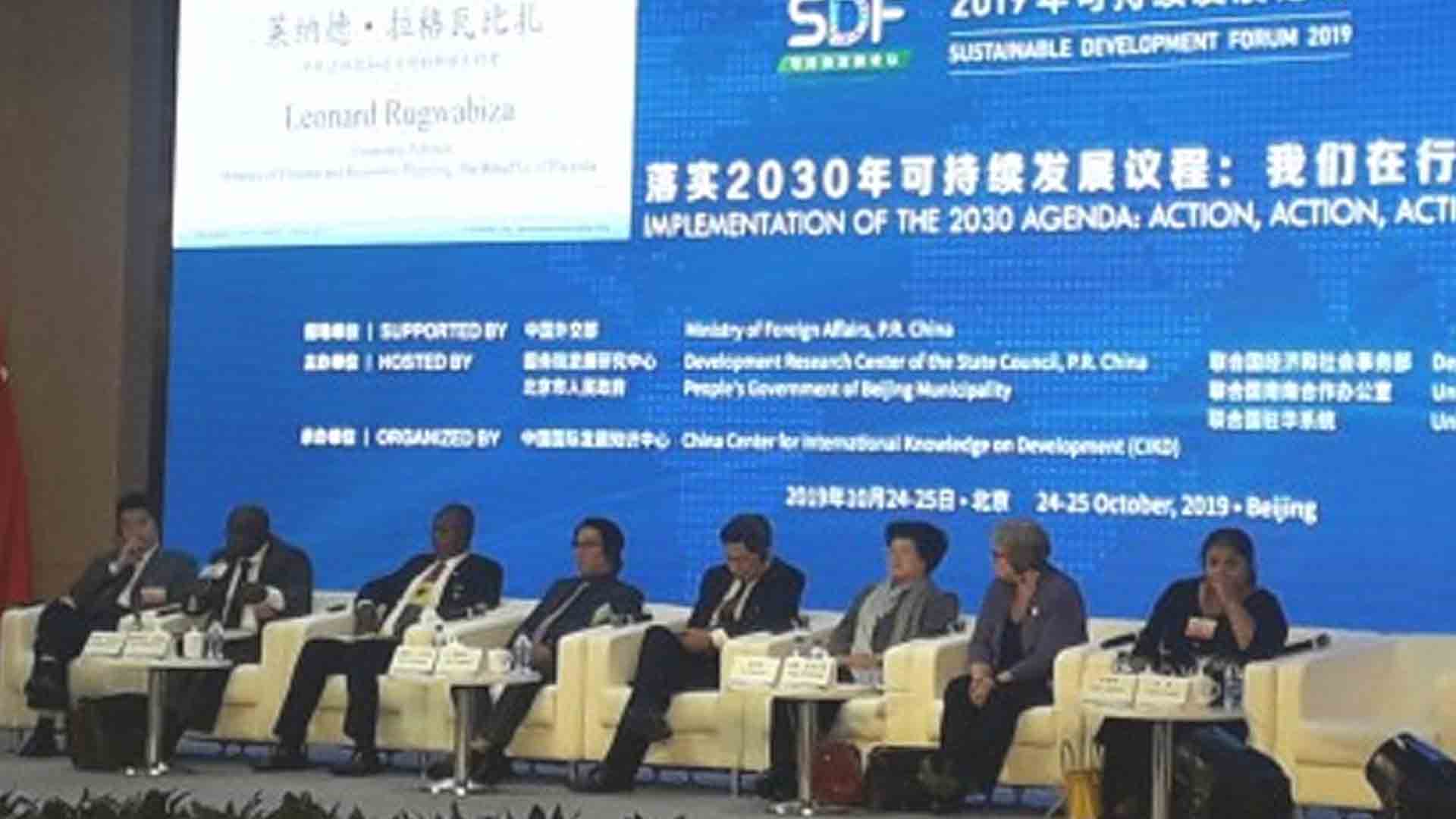






National Anti-Poverty Commission (NAPC) Secretary and Lead Convenor Noel Felongco has shared the Philippine government’s efforts in implementing the Sustainable Development Goals 2030 here Thursday.
During the Sustainable Development Forum 2019 at World Harmony House in Beijing, Felongco said the Philippine government has passed laws that will help achieve the SDG such as the Magna Carta for the Poor, Universal Health Care Law, the Free Tuition Law, and the Pantawid Pamilyang Pilipino Program, a law institutionalizing the conditional cash transfer (CCT) for poor families.
Felongco said the Magna Carta for the Poor seeks to uplift the living standards of Filipinos by ensuring that the poor have access to basic social services.
The Universal Health Care Law, on the other hand, automatically registers all Filipinos in the National Health Insurance Program, providing them access to health services while being protected from financial burden.
He said the country also promotes quality tertiary education by providing free tuition to develop the country’s human capital.
The NAPC chief added that the Duterte administration has also institutionalized the CCT Program which gives financial aid to marginalized sector to respond to their immediate needs and social development, and also providing special offers on education and healthcare needs.
“We recognize that these policies are just the tip of the iceberg in fully understanding in solving the challenges that we are facing today,” Felangco said.
“Our ambition is for all Filipinos to enjoy a strongly rooted comfortable and secure life where no one is left behind,” he said.
United Nations Undersecretary-General for Economic and Social Affairs Liu Zhenmin said countries should speed up their progress in implementing the SDG 2030.
“Indeed, we are facing urgent and an uncertain future. We must rebuild trust in the multilateral system by putting people first and promoting inclusive globalization and sustainable solutions,” Liu said, adding that poverty reduction is slowing down on the backdrop of sluggish economic growth, trade frictions, and investment sentiments.
“We must build on this momentum and proceed in full speed, guided by science and accelerating by technology and innovation,” Liu said.
“We can rebuild first by focusing on key areas that could that could generate a breakthrough towards implementation of the 2030 Agenda. We can rebuild trust by advancing partnership effectively translate our policies into action,” he added. (PNA)


