



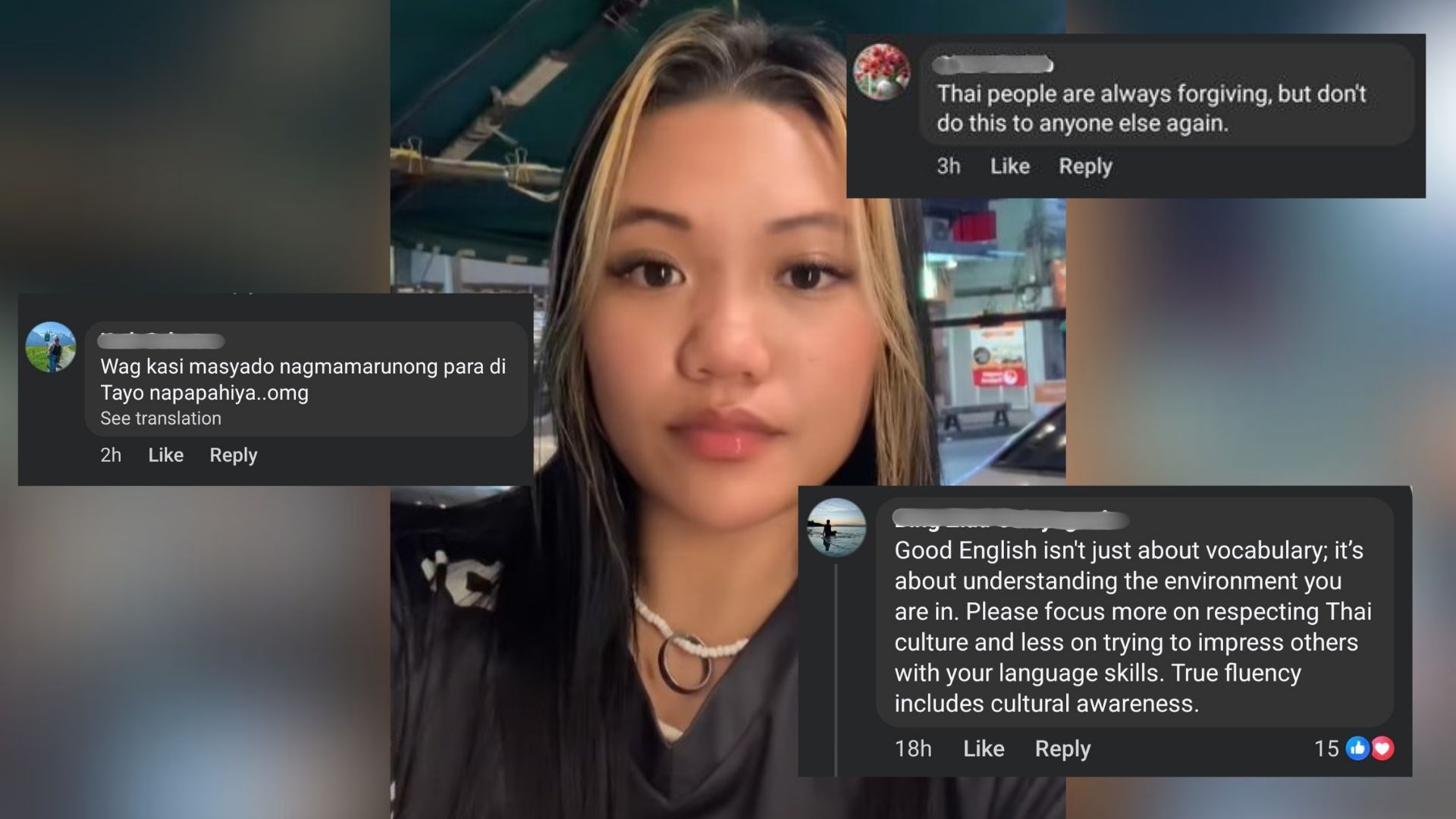






A Filipina tourist who went viral for her heated remarks about English communication in Thailand has released an apology video, following days of intense online criticism and a wider Southeast Asian conversation about cultural respect and language privilege.
The tourist, identified as Ann Berdin, became an online sensation after a travel vlog clip circulated across platforms showing her venting about her struggle to communicate with locals in Bangkok. In the deleted viral video, she was quoted saying, “I’m Filipina. Of course my English is good, but when I arrive in Thailand, it’s f-ing useless,” before adding that locals and Grab drivers “need a translator.”
The remarks were met with swift backlash, especially from Thai netizens, who argued that Thailand’s official language is Thai and that English fluency is not a requirement for hospitality. The controversy rapidly expanded beyond one tourist’s complaint into a region-wide discussion, drawing responses from Filipinos, Southeast Asians, and travel commentators about entitlement, tourism behavior, and the assumptions travelers carry when visiting non-English-speaking countries.
In her newly uploaded apology video, Berdin opened by addressing the controversy directly and clarifying her intent behind the original vlog, which carried the caption “Filipina in Thailand.”
“I just want to make things clear about the video I made… While I was doing that video, I didn’t mean anything hateful about Thailand,” she said.
Berdin explained that she was only sharing her personal travel experience and defended her mention of translation tools, saying she did not see the statement as “looking down” on Thai people because she also uses translators herself.
She further acknowledged her own limitations in speaking English.
“To me, I admit I don’t have enough good English, but at least I can speak a little bit, and I can understand,” she said.
However, she also admitted that the way she expressed herself may have sounded offensive.
“I think it sounds a little bit as wrong,” she said, adding that she “said it in the wrong words.”
In the apology, Berdin repeatedly stressed that she did not intend to insult Thai people, particularly regarding English ability, but recognized that viewers may have interpreted the message differently.
“So if you see it and you find it not good, I’m gonna say I’m sorry… I didn’t mean anything bad,” she said.
She closed the statement with a final message:
“Once again, I’m sorry if you find it wrong…”
As of publication, Berdin’s apology video has garnered 158K views on Facebook, drawing thousands of reactions and comments.
The original incident, struck a nerve because it touched on larger issues beyond one traveler’s frustration. Critics pointed out that language barriers are part of cross-cultural travel and that expecting English to function as a default in another country reflects deeper assumptions about privilege and mobility in modern tourism.
The report noted that Thai netizens were particularly vocal, expressing disappointment that a visitor would publicly shame locals rather than acknowledge the realities of traveling in a foreign environment.
With the apology now circulating online, the controversy enters a new phase—one that tests how audiences respond when a viral figure attempts to clarify intent, admit wording mistakes, and say sorry after a public backlash.
For many observers, the situation remains a reminder that in the age of social media travel culture, personal videos do not stay personal for long, and what is said in frustration can quickly escalate into a cultural flashpoint.


