









The Association of Southeast Asian Nations (ASEAN) and Japan are strengthening cooperation on supply-chain resilience, energy security and regional economic stability amid rising geopolitical tensions, trade uncertainties and volatility in global energy markets.
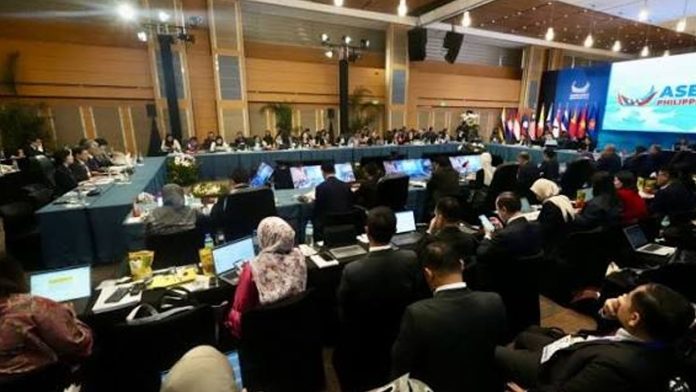
These were among the key topics of the 32nd ASEAN Economic Ministers – Ministry of Economy, Trade and Industry Consultation held at the Philippine International Convention Center in Pasay City on Sunday, co-chaired by Trade Secretary Ma. Cristina Roque and Japan’s Minister of Economy, Trade and Industry Akazawa Ryosei.
The meeting noted rising geopolitical tensions, trade-related uncertainties, and regional conflicts continue to “affect the stability and predictability of the international economic environment, creating a challenging operating environment, particularly for micro, small and medium enterprises.”
It also noted increased volatility in global energy markets, including risks to key energy supply routes such as in the Middle East, or any straits used for international navigation and its potential implications for global supply chains.
In response, the ASEAN and Japan ministers stressed the need to strengthen cooperation on supply-chain resilience, energy security, regional stability and global resilience.
Japan’s Partnership on Wide Energy and Resources Resilience and the realization of the Asia Zero Emission Community 2.0 were likewise discussed.
Japan proposed cooperation in key sectors, including semiconductors, critical minerals, biofuels and the circular economy, to strengthen regional economic resilience.
The meeting further welcomed progress in implementing the Future Design and Action Plan of Innovative and Sustainable ASEAN-Japan Economic Co-Creation 2023-2033, which serves as a long-term framework for advancing economic relations.
The plan focuses on cyber-physical connectivity, open innovation, human capital development and sustainability.
On trade, the ministers reaffirmed the importance of the ASEAN-Japan Comprehensive Economic Partnership (AJCEP) as a foundation of ASEAN-Japan economic relations and welcomed efforts to improve its utilization, including the completion of the transposition of product-specific rules into the Harmonised System 2022.
They also welcomed progress toward a possible upgrade of the AJCEP and the commencement of a joint feasibility study by the Economic Research Institute for ASEAN and East Asia, including possible measures to strengthen supply-chain resilience.
The meeting noted that ASEAN-Japan two-way merchandise trade reached USD245.4 billion in 2025, while Japanese foreign direct investment (FDI) into ASEAN totaled USD9.5 billion during the same year.
The figures placed Japan among ASEAN’s five largest trading partners and five largest sources of FDI in 2025. (PNA)