



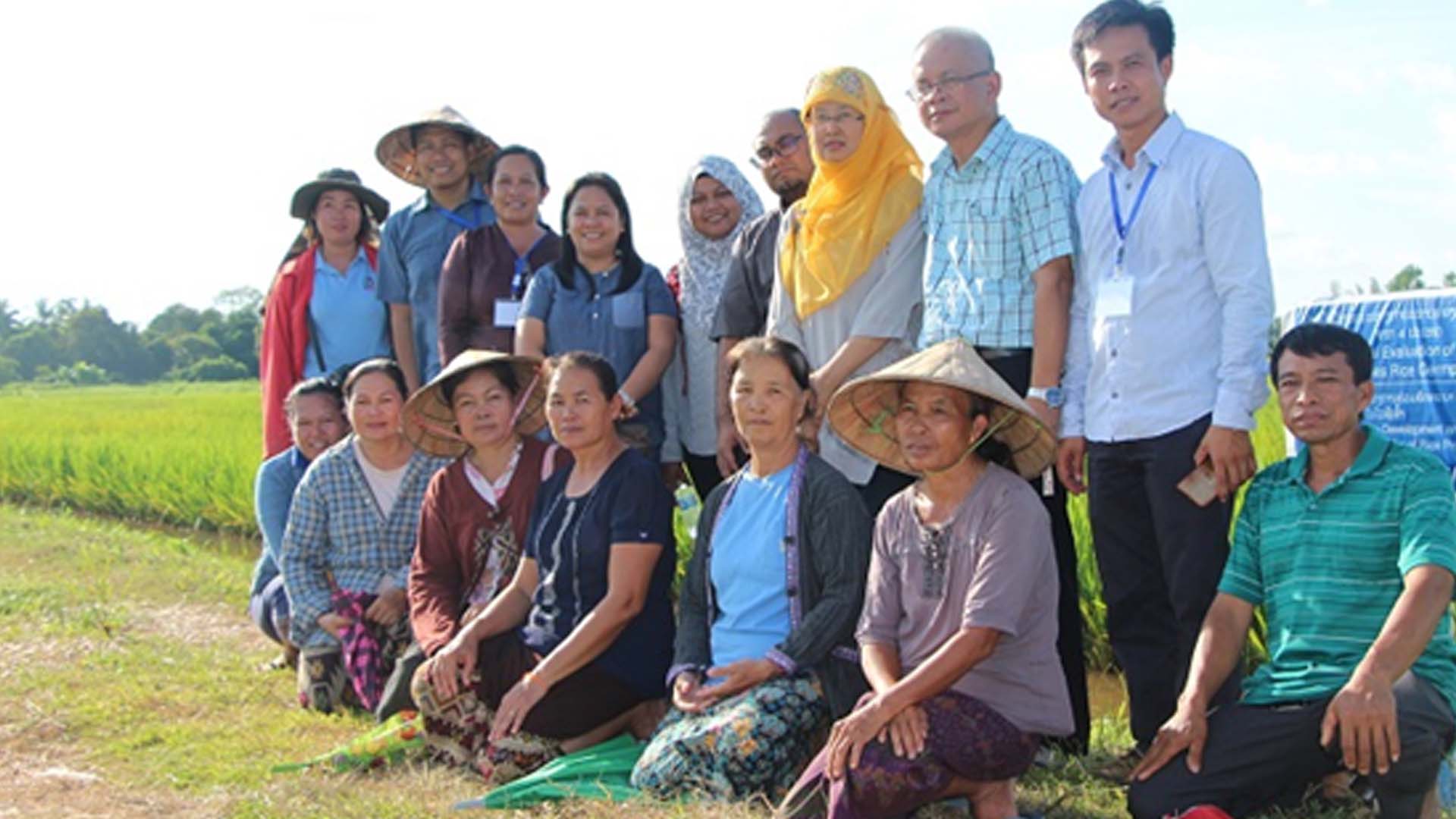






To help develop quality, climate-change resilient varieties, the Philippines has been part of the ASEAN (Association of Southeast Asian Nations) collaboration on rice technologies and germplasm since 2016.
Through the Department of Agriculture-Philippine Rice Research Institute’s (DA-PhilRice) Genetic Resources Division, the Philippines, Malaysia, and Lao PDR have been effecting material exchanges with agreed intellectual property coverage. To be completed this year, the collective pool has opened pathways to identifying promising genetic make-ups.
“Techno-transfer and knowledge-sharing that will benefit institutions and farmers had been the focus of the project,” said senior researcher Xavier Greg I. Caguiat, DA-PhilRice’s representative in the project.
Already, 106 rice varieties were exchanged, pooled, and documented among participating countries. Characterized were 88 local varieties and 18 modern varieties based on morpho-agronomic traits and grain quality, and through molecular markers.
“Indonesia and the Philippines have varieties with resistance to blast and bacterial leaf blight (BLB), which were shared to Lao PDR to address blast infestations,” he said.
In partnership with the UN’s Food and Agriculture Organization (FAO), the project has involved and trained around 15,600 smallholder ASEAN farmers and landless laborers, and benefitted 400 scientists and researchers.
Valuing traditional rice varieties (TRVs)
Through this project, FAO also helped DA-PhilRice genebank to characterize unexplored TRVs in 17 barangays in Hungduan and Hingyon in Ifugao, and in Lake Sebu, South Cotabato. Rice Biodiversity Seed Fairs were conducted as avenues for trade opportunities among municipalities. These activities were carried out to safeguard the seed sources of next-generation farmers through the dynamic conservation of indigenous rice varieties.
“Rice landraces may contain important genes with tolerances to abiotic stresses such as drought, salinity, flooding; and to biotic stresses, which include blast, BLB, and brown planthopper infestation,” Caguiat said.
He added that the ASEAN collaboration has included genome re-sequencing of selected local rice varieties, and genome wide genotyping of all local varieties using SNPs or single nucleotide polymorphisms.
“The activities also provided the means for capacity-building, surveying, and interacting with the indigenous people – the first stewards of indigenous varieties of crops,” Caguiat said.
The DA-PhilRice genebank gave technical support to the structure, operation, and management of 17 Community Seed Banks (CSB) in Ifugao and South Cotabato. They are now using traditional (bamboo poles) and modern (glass jars) methods for seed storage.
As the community’s TRV repository for immediate use, CSB implements the 1kg:2kg borrow-and return scheme to sustain the preservation of their local rice varieties.
DA-PhilRice likewise made available the micro-tiller suitable for the rice terraces in Ifugao.
“Participative surveys and focus group discussions highlighting the traditional practices of the indigenous communities were also conducted,” Caguiat said.
The projects are funded by the BenefitSharing Fund and Global Environment Facility.


