



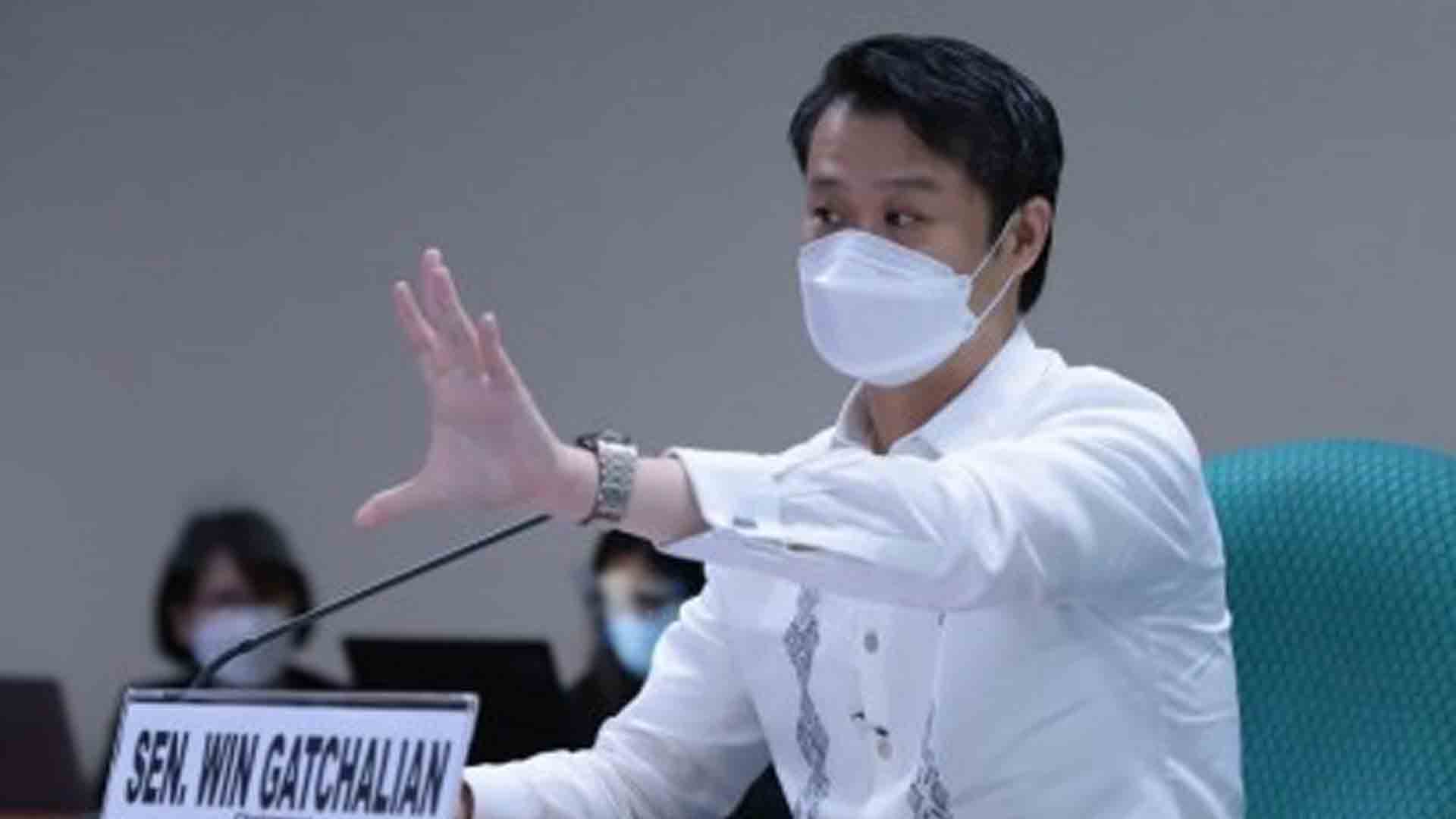






Though around 59 percent of more than 22 million learners enrolled in public schools are using printed self-learning modules (SLMs) for distance learning, Senator Win Gatchalian said learning through television-based instruction is a big help in teaching more difficult and complicated subjects.
During the first day of classes, Gatchalian made rounds among Valenzuela’s households to see how parents and learners were coping with distance learning.
In one household, Gatchalian met a learner studying fractions, which he said could be challenging to understand without the guidance of a teacher.
This is where videos should be helpful in teaching the learners, Gatchalian said, noting that these would feature teachers going through the lessons step by step.
Gatchalian added that television-based instruction should be leveraged in teaching difficult lessons, noting that television has a wider reach in the country compared to the internet.
Global data firm Dataxis revealed that in 2019, 18.7 million households in the Philippines have their own TV sets at home. Last August, the Department of Education’s (DepEd) enrollment data showed that around 6.3 million households have no internet access.
“I looked at some of the modules. Some of the subjects are very complicated, like geometry or trigonometry. I see a lot of computations. It’s very difficult for an ordinary student to pick it up right away. This is where the TV and radio modalities would come in. TV, in this particular case, would play a very big role,” Gatchalian said in a press release issued on Sunday.
To roll out the use of television-based instruction, the Department of Education (DepEd) launched DepEd TV, which airs K to 12 subjects from 7 a.m. to 7 p.m., Monday to Saturday. The lessons are being aired on state-run Intercontinental Broadcasting Corporation (IBC-13), People’s Television Network (PTV-4), and other channels that partnered with DepEd.
To complement the reach of DepEd TV, Gatchalian cited the role of partnerships between local government units and local radio and television stations, which can air localized episodes.
The Senate Committee on Basic Education, Arts and Culture chairman, however, flagged a recent error in a math lesson that aired on DepEd TV, which has since gone viral on social media.
While DepEd has already apologized for the error and vowed to address it, Gatchalian reiterated that quality control of lessons should never be compromised.
Gatchalian again urged telecommunication companies to ensure the stability of internet connectivity to avoid online learning woes. He cited the case of the Valenzuela Live Online Streaming School, which utilizes Facebook Live to broadcast lessons.
Despite the airing of these lessons, some learners cannot view or stream the lessons because of connectivity problems, Gatchalian explained.
He added that while they are expecting as many as 10,000 students to watch per lesson, some 3,000 students are not able to watch. (PNA)


